Vegan High-Protein Meal Prep: The Numbers That Actually Matter
Quinoa needs 682 grams to deliver 30 g of protein. Seitan needs 120. Most vegan protein advice never tells you that, or why plant protein is scored differently in the first place.

Every list of vegan protein sources includes quinoa. Quinoa is a fine grain and it is not a protein source: you would need to eat 682 g of it cooked — about five cups — to get 30 g of protein.
That single number is why so many people go plant-based, follow the advice, and quietly end up under-eating protein for months without noticing. The lists are not wrong about which foods contain protein. They are wrong about the quantities, and silent about the part that actually matters, which is protein quality.
So this is the arithmetic first, then how to batch cook around it.
- target
- 1.6-2.0 g/kg per day
- per meal
- 35-40 g
- session
- 90 min
- cost
- ~$2.90 per portion
#Which vegan foods actually deliver protein?
Seitan, soy and legumes — in that order by concentration. Everything else is a supporting act.
Here is the number that matters, worked out from USDA FoodData Central composition data: how much of each food you would have to eat to land a 30 gram serving.
#Why quinoa keeps appearing on these lists
Because it is a complete protein, which is a different claim from being a high-protein food, and the two get conflated constantly.
Quinoa contains all nine indispensable amino acids in reasonable proportion. It also contains only 4.4 g of protein per 100 g cooked. Being complete is a statement about composition; being high-protein is a statement about quantity. Quinoa passes the first test and fails the second.
#The three that carry a vegan meal plan
Seitan at 25 g per 100 g, tempeh at 19 g and tofu at 17 g. Those are the only whole foods dense enough that a normal portion does real work.
Legumes matter enormously — for fibre, cost and volume — but a cup of lentils is about 18 grams, not 30. Plan around that rather than being disappointed by it.
#Is plant protein worse than animal protein?
Not worse, but scored lower — and the scoring is about amino acid composition, not about whether your body can absorb it.
#How protein quality is scored
#What DIAAS actually measures
DIAAS — the Digestible Indispensable Amino Acid Score — rates a protein by how well its amino acid profile matches human requirements, after accounting for how much of each amino acid is actually absorbed.
A score of 1.0 means the protein fully covers requirements. In the comprehensive DIAAS overview published in Food Science & Nutrition, animal proteins including casein and egg score above 1.0, whey lands around 1.07, and soy protein isolate reaches 0.91 — close enough that soy is classified as high quality alongside whey.
#Digestibility is not the problem
This surprises people. Measured true ileal digestibility of plant foods is high: around 97% for seitan, 95% for tofu, 94% for pea and 92% for soy milk.
Your gut handles plant protein perfectly well. What differs is the amino acid profile, and that is where the gap sits.
#Which amino acids run short, and in what
Cereals are limited by lysine. Legumes are limited by the sulfur-containing amino acids, methionine and cysteine.
That is the entire biochemical basis of the beans-and-rice tradition, and it is why the pairing works: grains supply the methionine legumes lack, legumes supply the lysine grains lack.
| Food group | Limiting amino acid | Pairs well with |
|---|---|---|
| Wheat, rice, oats, corn | Lysine | Legumes, soy |
| Lentils, beans, chickpeas | Methionine, cysteine | Grains, seeds, nuts |
| Soy (tofu, tempeh, edamame) | None significantly | Nothing needed |
| Seitan | Lysine, heavily | Legumes, soy |
#Do you have to combine proteins at every meal?
No. That advice is decades out of date and it made vegan eating sound far more fiddly than it is.
Your body maintains a pool of free amino acids and draws on it across the day. What matters is that the day contains a mix of sources, not that each individual plate is balanced. Beans at lunch and rice at dinner works exactly as well as beans and rice together.
The one place pairing still matters practically is seitan, which is so heavily lysine-limited that eating it as your only protein at a meal genuinely wastes some of it.
#Do vegans need more protein than omnivores?
Somewhat more, yes — a reasonable working adjustment is 10 to 20% above the omnivore target.
The daily anchor is the same: the 2018 British Journal of Sports Medicine meta-analysis of 49 studies found gains from resistance training plateauing past roughly 1.62 g of protein per kilogram of bodyweight a day. Because plant sources score lower on DIAAS, the practical plant-based target sits nearer the top of the usual range rather than the bottom.
#Why the per-meal dose has to be bigger
Because muscle protein synthesis is triggered by reaching a leucine threshold — roughly 2.5 to 3 g in a sitting — and plant proteins are generally lower in leucine than animal ones.
So where an omnivore might hit that with 25-30 g of protein, a plant-based meal usually wants 35-40 g to be confident of clearing the same bar. That is one number, and it changes how you portion everything below.

#How do you build a 40 g vegan bowl?
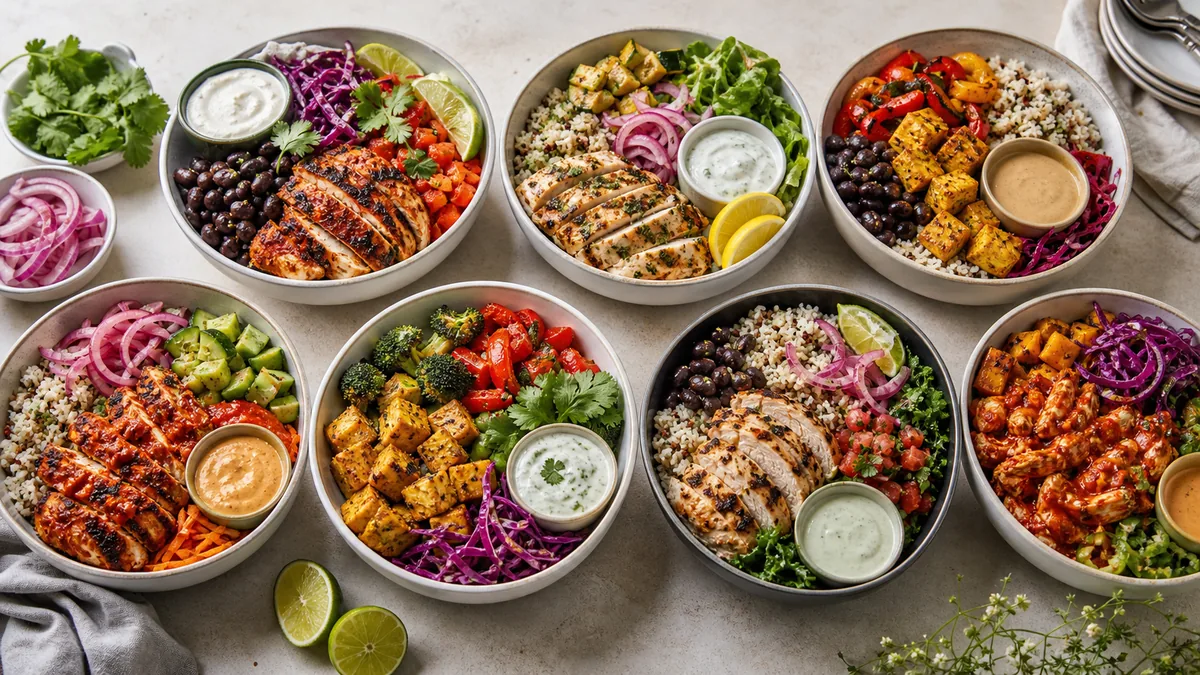
Four layers, and the order is deliberate. Anchor first, legume second, grain third, sauce last.
- Anchor 200 g Tofu, tempeh or seitan — 34 to 50 g protein
- Legume 150 g Lentils or chickpeas cooked — 13 g and the fibre
- Grain 150 g Rice, bulgur or farro — 5 g and the volume
- Sauce 60 g Tahini, peanut or soy-yoghurt — 5 g and the reason you finish it
#Why the anchor goes in first
Because it is the only layer where the number moves much. Swapping rice for bulgur changes the total by a gram or two; swapping lentils for seitan changes it by twenty.
Build the plate around the dense thing and let the rest be about texture, fibre and pleasure.
#What the sauce is quietly contributing
More than people think. Tahini is 17 g per 100 g, peanut sauce similar — a generous 60 g spoonful adds around 5 g and makes day-four food edible, which is the real constraint in any prep plan.
#What should you batch cook?
Anchors and legumes on prep day; grains and anything raw as late as possible.

- Prep day
- Bake tofu
- press tempeh
- cook lentils
- Mon
- Tofu bowl
- lentils
- tahini
- Tue
- Tempeh
- chickpeas
- peanut sauce
- Wed
- Seitan stir-fry
- edamame
- Thu
- Lentil dal
- rice
- soy yoghurt
- Fri
- Tofu scramble
- black beans
#The three things worth cooking in bulk
We cooked this rotation for three weeks straight before writing it down, mostly to find out which parts got boring first. It was never the tofu — it was always the sauce.
#Baked tofu, 800 g
Press 20 minutes, cube, toss with soy sauce, cornflour and sesame oil, bake 25 minutes at 200°C / 400°F until the edges crisp. Cornflour is what gives it a surface rather than a sponge.
#Tempeh, 400 g
Steam it 10 minutes before marinating. This removes the bitterness people dislike and lets the marinade actually penetrate — skipping the steam is why most people think they hate tempeh.
#Lentils, 500 g dry
Plain, in water, no salt until the end. Cook the whole bag and freeze half in portions; they behave exactly like the tinned version at a third of the cost.
#How long does it keep?
Baked tofu and tempeh, four days. Cooked lentils, five. Sauces, four to five. The same rules as anything else — cool on trays, refrigerate inside two hours, and our storage guide has the food-by-food detail.
#Do you need a protein powder?
Not for health, and often for convenience. Thirty-eight grams of pea or soy isolate delivers a full 30 gram serving with no cooking and no volume, which is a genuinely useful tool on a day that got away from you.
Soy and pea isolates both score respectably on DIAAS, and blends cover each other's limiting amino acids. What powder cannot do is provide the fibre, potassium and satiety that 333 g of lentils brings with it.
#What this does not solve
It does not address vitamin B12, iron absorption, omega-3 or iodine, all of which need separate attention on a plant-based diet and none of which are protein questions. Those are worth a conversation with a dietitian rather than a food site.
It also assumes you like tofu. If you do not, the honest answer is that a high-protein vegan plan gets considerably harder and considerably more expensive, because soy is doing most of the heavy lifting here.
#Bake a tray of tofu tonight
Press it, cube it, cornflour, hot oven. It takes thirty-five minutes, most of which is the oven's time, and it is the single component that makes every bowl this week clear 40 g without effort.
Once that is in the fridge, the rest is legumes and a good sauce — and if you want the wider session structure, our 90-minute Sunday plan is the order of operations.