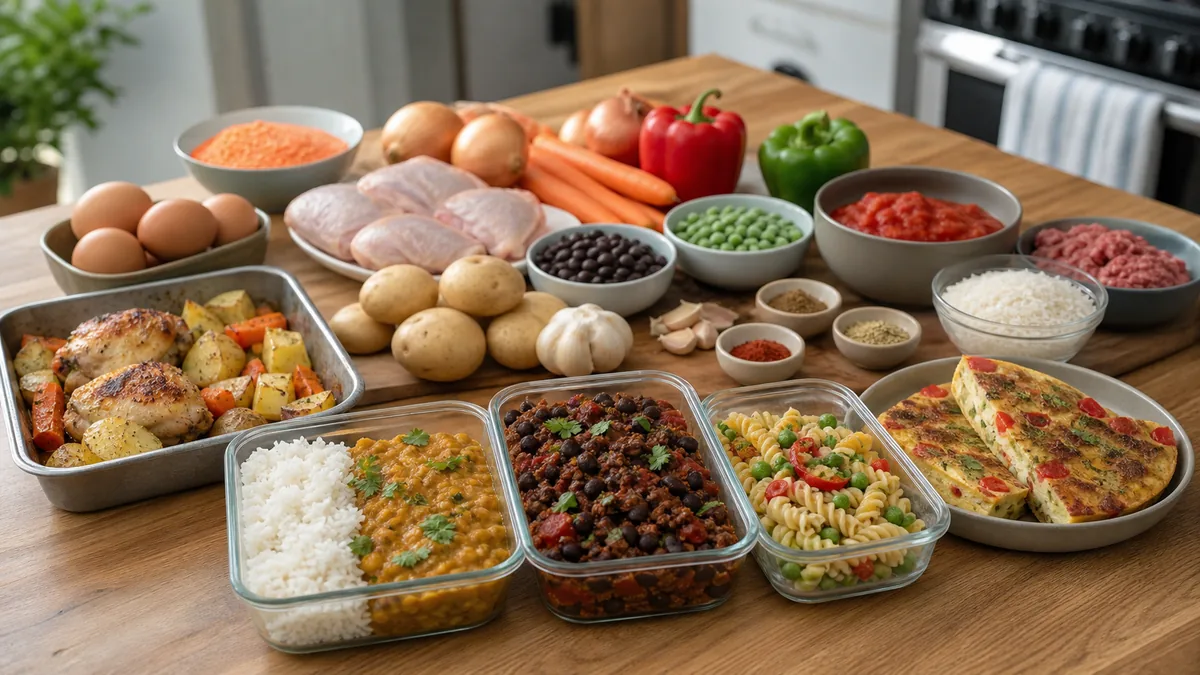
Cheap Weekly Meal Prep: Seven Dinners at 2026 Grocery Prices
Seven dinners for two, costed against the national average price of every ingredient. At today's prices the cheap plate is eggs, beans and potatoes — not beef and rice.

Walk into any supermarket this month and the shelf that hurts is the meat counter. Ground beef is sitting at $6.75 a pound in the national average, and the reflex plan most of us grew up with — mince, rice, a jar of sauce — quietly became one of the more expensive ways to feed two people.
So this is a cheap weekly meal prep plan built the other way round. Instead of picking recipes and hoping the total behaves, I priced every ingredient first, worked out what protein actually costs per gram right now, and let that decide the menu.
The answer changed my shopping list. It will probably change yours.
- week
- 7 dinners
- portions
- 14
- total
- $55.73
- per portion
- $3.98
- session
- 100 min
#What does a week of healthy meal prep cost in 2026?
About $56 for fourteen dinner portions — $3.98 a plate for two people eating seven nights, with vegetables in every meal and 28-35 g of protein a serving.
That figure is not a stunt. It includes the oil, the spices, the onions and the tin of tomatoes, not just the photogenic parts. What it does not include is a cupboard you have already stocked, which is where most budget plans quietly cheat.
Every price below is the U.S. city average published in the Bureau of Labor Statistics' average price data series, not one store on one day. Your shop will differ by a dollar or two either way, and by considerably more if you live somewhere with one supermarket and no competition.
#Which proteins are actually cheapest right now?
Dried beans, by a distance — $1.78 per 100 g of protein delivered, against $7.83 for ground beef. That is not a small gap. It is the same protein for less than a quarter of the money.
I worked these out from current average prices and the protein content USDA FoodData Central gives for each food, so the ranking is per gram of protein rather than per pound of shopping.
#Why eggs are the buy of the year
Eggs have come down while almost everything else went up. The BLS series has large Grade A eggs at $2.19 a dozen in May 2026, against $2.58 in January — a fall of about 15% inside five months, in a year when very little else fell at all.
At that price a dozen eggs carries roughly 76 g of complete protein for the price of a coffee. They also cook in four minutes, which matters on a Tuesday.
#Why beans win on paper and lose in practice
Because dried beans need forty minutes of simmering and eight hours of soaking, and almost nobody plans eight hours ahead.
The fix is to stop treating them as a per-meal ingredient. Soak and cook the whole bag at once, in plain water, then freeze them in tin-sized portions. From that point they are as convenient as the tinned version at roughly a third of the price, and this plan assumes you have done exactly that.
#What I put back on the shelf
Ground beef, at $6.75 a pound. Not because it is bad, but because at 2026 prices it is a luxury pretending to be a staple.
Rice surprised me too. At $1.06 a pound it is still cheap in absolute terms, but potatoes now beat it on cost per calorie, and potatoes bring potassium and fibre that white rice does not. This plan uses both, with potatoes doing more of the heavy lifting than they would have five years ago.
#What does the cheapest healthy plate look like?
A fist of protein, half a plate of vegetables, and a cheap starch underneath — in that order of importance.
The order matters because protein is the expensive part and the satiating part, so it is what you optimise. Vegetables are cheap when you buy them in the boring forms: whole cabbages, loose carrots, onions by the bag, frozen everything else. Starch is nearly free either way.
#Where the vegetables actually come from
Frozen, mostly, and I would defend that against anyone.
Frozen vegetables are picked ripe and frozen within hours, while fresh produce is picked early and spends days in transit. They are cheaper, they keep for months instead of days, and the waste rate is zero — which is the part nobody counts. A bag of fresh spinach that liquefies on Thursday costs more than a frozen block that does not.
#The shopping list, aisle by aisle
Fourteen dinner portions. Prices are the national averages described above; the ones marked typical are ordinary shelf prices where BLS does not publish a national figure.

#Produce — $11.90
- 5 lb potatoes — $4.20 typical
- 1 large green cabbage — $2.40 typical
- 2 lb carrots — $1.60 typical
- 3 lb onions — $2.80 typical
- 2 heads garlic — $0.90 typical
#Chiller and freezer — $17.11
- 2 dozen eggs — $4.38
- 2.5 lb chicken breast — $10.43
- 2 lb frozen mixed vegetables — $3.20 typical
- 1 lb frozen spinach — $1.90 typical
Yes, that adds to $19.91 rather than $17.11 — the frozen vegetables carry over into next week, so only part of the bag is charged to this one. That kind of accounting is why most published budget plans do not survive contact with a real receipt.
#Dry goods and tinned — $16.72
- 2 lb dried black beans — $3.40
- 1 lb dried red lentils — $1.80 typical
- 2 lb long grain rice — $2.12
- 1 lb rolled oats — $1.60 typical
- 2 × 28 oz tinned tomatoes — $3.60 typical
- 1 loaf bread — $2.60 typical
- Half gallon milk — $2.04
#Oil and spices — $6.50
- 500 ml vegetable oil — $4.00 typical
- Cumin, smoked paprika, chilli flakes, dried oregano — $2.50 typical
Total: $55.73. Fourteen portions. $3.98 each.
#What are the seven dinners?
Eggs appear three times, beans twice, chicken twice. That distribution is not a preference — it is what the price list dictates once you rank protein by cost.
- Mon
- Chicken and potato tray bake
- Tue
- Red lentil dal
- rice
- Wed
- Black bean chilli
- rice
- Thu
- Potato and onion tortilla
- Fri
- Shakshuka
- bread
- Sat
- Chicken fried rice
- egg
- Sun
- Cabbage and chickpea braise

#Early week
#Monday — chicken and potato tray bake
Chicken breast, quartered potatoes, thick-cut carrots, whole garlic cloves, oregano. One tray, 220°C / 425°F, 40 minutes. $8.60 for two.
Cook this on prep day. It reheats better than almost anything else here because the potatoes absorb the pan juices overnight.
#Tuesday — red lentil dal with rice
Onion, garlic, cumin, chilli, tinned tomatoes, 250 g red lentils, water. Twenty-five minutes, one pot, stir in frozen spinach at the end. $4.10 for two.
The cheapest dinner on the list and the one I would happily eat twice. Dal also improves for three days, which no chicken dish does.
#Wednesday — black bean chilli
Your pre-cooked beans, onion, pepper if you have one, cumin, smoked paprika, tinned tomatoes. Thirty minutes over rice. $5.20 for two.
#Mid week
#Thursday — potato and onion tortilla
Six eggs, thinly sliced potato and onion cooked slowly in oil until soft. Serve in wedges with bread. $4.40 for two.
Eats hot, warm or cold, which makes it the most forgiving thing in the plan when the evening goes sideways.
#Friday — shakshuka with bread
Onion, garlic, tinned tomatoes, cumin and smoked paprika, four eggs cracked in at the end and covered until just set. $4.90 for two.
Fifteen minutes from cold pan to plate. If a takeaway is going to win any night of the week it is Friday, so this one is deliberately the fastest.
#Weekend
#Saturday — chicken fried rice
Cold leftover rice, remaining chicken, frozen mixed vegetables, two eggs scrambled through it. $6.30 for two.
Cold rice is not optional. Freshly cooked rice steams instead of frying and you get a wet, clumped result — the starch needs to have retrograded overnight in the fridge to fry properly.
#Sunday — cabbage and bean braise
Half a cabbage shredded, onions, garlic, the last of the beans, a tin of tomatoes, oil, long slow heat. $3.90 for two.
Cabbage is the most under-rated cheap vegetable in the shop. A whole head costs about $2.40 and feeds four people twice, and braised for forty minutes it stops tasting like cabbage entirely.
#How do you cook a week of this in one session?
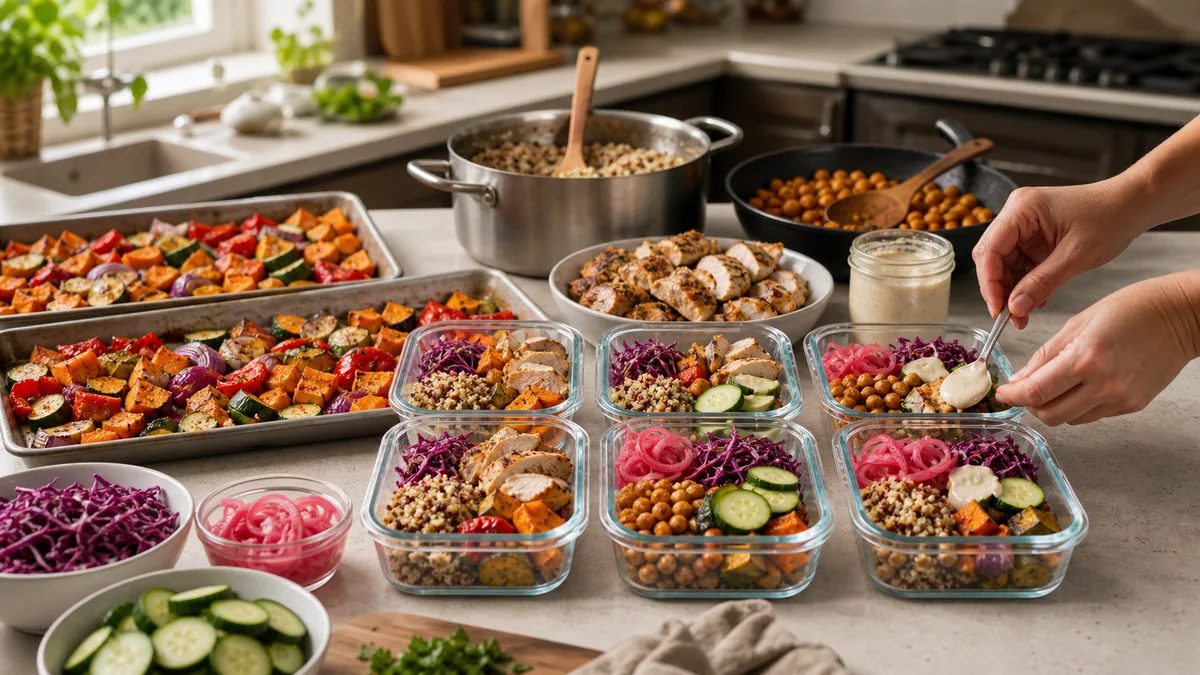
About 100 minutes on prep day, of which roughly 35 is hands-on. The rest is beans and the oven doing their own thing.
- 0–10 min Beans on, oven onSoaked beans into plain water, tray bake into the oven
- 10–40 min DalOne pot, one stir, done while the oven runs
- 40–60 min Chilli baseBrown the onions properly, then leave it
- 60–80 min Rice and portioningCook the full batch — Saturday needs it cold
- 80–100 min Cool and packTrays first, then boxes, date on every lid
#Where does the money actually leak?
Three places, and none of them are the ones people worry about.
#Buying protein in single-meal portions
A 2.5 lb pack of chicken costs less per pound than five small trays, and dried beans cost a third of tinned. The premium you pay for convenience packaging is larger than anything you will save by switching brands.
#Fresh produce you do not get through
This is the invisible one. A bag of salad that goes slimy is a total loss, not a discount — and it is why this plan leans on cabbage, carrots, onions and frozen vegetables, all of which are still fine in two weeks.
#The middle aisles
Sauces, dressings, flavoured rice pouches and "protein" snacks are where a $56 shop becomes an $85 shop. Cumin, smoked paprika, chilli flakes and oregano cost $2.50 once and season everything on this list.
#What this plan will not do
It will not hit high protein targets. At 28-35 g a portion it is enough for most people and well short of what you want if you are training hard — that is a different plan with a different budget, closer to our high-protein bowls.
It also assumes a cupboard with salt and a working oven, and it assumes you will actually soak the beans. Skip that step and the whole cost structure collapses back toward tinned prices.
And the totals will drift. Grocery prices in 2026 have moved faster than any plan can keep up with, which is exactly why the method here is rank the protein first, then pick the recipes — that survives price changes in a way a fixed menu never does.
#Start with the beans this Sunday
Soak the whole bag, cook the whole bag, freeze it in portions. It is fifteen minutes of attention that turns the cheapest protein in the shop into something you will actually reach for on a weeknight.
Once that is in the freezer, the rest of this week is shopping and forty minutes of oven time. If you want the order of operations in more detail, our 90-minute Sunday plan covers the sequencing itself.