A Heart-Healthy Week: Seven Dinners Built on What the Trials Actually Found
The biggest lever a home cook has is not an ingredient. It is the act of cooking at all — because that is where the sodium goes. Seven dinners, and the evidence behind each decision.

Most heart-healthy eating advice arrives as a list of virtuous foods. Salmon, walnuts, olive oil, oats. You read it, agree with it, and change nothing, because a list of foods is not a week of dinners.
The more useful way in is to ask what the trials actually measured, and then work backwards to the pan. Two numbers do most of the work — a sodium target and a saturated fat ceiling — and one large trial gives a sense of what a whole eating pattern is worth.
And the single most effective thing on this page is not an ingredient at all. It is that you cooked, rather than bought it ready-made.
- week
- 7 dinners
- portions
- 14
- sodium target
- under 2,300 mg/day
- sat fat budget
- ~13 g/day
- session
- 95 min
#What do the guidelines actually ask for?
Two numbers. The American Heart Association asks for sodium under 2,300 mg a day, ideally down to 1,500 mg where more blood pressure lowering is wanted, and saturated fat under 7% of calories — under 6% for people already at cardiovascular risk, per the AHA scientific statement.
On a 2,000 calorie day, that 6% ceiling works out at roughly 13 g of saturated fat. Which is one and a half tablespoons of butter, or about 100 g of cheddar, for the entire day.
#Why the salt shaker is the wrong place to look
Because the large majority of sodium in a typical diet arrives already inside the food — packaged meals, bread, sauces, deli meat, restaurant portions — rather than from the salt you sprinkle at the table.
This is the whole reason a meal prep site is a reasonable place to read about heart health. You cannot season your way past a diet of ready meals, and you cannot easily overshoot 2,300 mg cooking dried lentils and vegetables from scratch, even salting them properly.
Cooking is the intervention. The recipes are details.

#Does the Mediterranean diet really cut heart risk by 30%?
The headline number is real and the framing around it is usually not.
PREDIMED randomised 7,447 adults at high cardiovascular risk in Spain to a Mediterranean diet supplemented with extra-virgin olive oil, the same diet with mixed nuts, or a reduced-fat control diet. Over a median of 4.8 years, the trial as republished in the New England Journal of Medicine in 2018 found roughly a 30% lower relative risk of major cardiovascular events.
#What 30% means in absolute terms
About three fewer events per 1,000 people per year.
That is the number almost nobody quotes, and it is the honest one. A 30% relative reduction sounds like a third of readers avoid a heart attack. It does not mean that. It means that in a high-risk population, over roughly five years, a meaningful but modest number of events were avoided.
Worth doing? Clearly. Worth the breathless framing food blogs give it? No. And you deserve the real figure rather than the exciting one.
#One more thing you should know about this trial
The original 2013 publication was withdrawn and republished in 2018 after irregularities were found in how some participants were randomised. The reanalysis reached materially the same conclusion, which is why the finding still stands — but a site telling you about PREDIMED without telling you that is not being straight with you.
#What does a heart-healthy plate look like?
Half the plate vegetables and legumes, a quarter whole grains, a quarter protein — and olive oil as the default fat.
That is the pattern the evidence keeps pointing at, and it is unglamorous on purpose. No single food on this plate is doing the work — the pattern is.
#Which choices carry the most evidence
#Olive oil as the main fat
It was the supplemented arm of PREDIMED that produced the effect, at around four tablespoons a day in that trial.
#Legumes several times a week
Cheap, high in soluble fibre and potassium, and they displace meat without anyone feeling deprived.
#Oats for soluble fibre
The FDA authorises a health claim for beta-glucan, the soluble fibre in oats, at 3 g a day in connection with heart disease risk — roughly 70 g of dry rolled oats.
#Oily fish, within reason
Twice a week is the standard guidance. The plan below hits it once, honestly, because salmon at current prices breaks most budgets.
#What comes down rather than out
Saturated fat, mostly from red meat, butter and hard cheese. Not banned — budgeted. Thirteen grams a day is not nothing; it is one modest portion of cheese, or the fat in a small amount of good sausage.
The plan below runs at roughly 8-11 g a day, which leaves room for you to be a person on Saturday.
#What are the seven dinners?
Legumes four times, fish once, poultry twice, red meat not at all. That distribution is the plan; the recipes are interchangeable.

- Mon
- Lentil and tomato stew
- bulgur
- Tue
- Roast salmon
- potatoes
- greens
- Wed
- Chickpea and spinach curry
- Thu
- Chicken
- olive oil beans
- lemon
- Fri
- White bean and kale soup
- bread
- Sat
- Chicken traybake
- peppers
- olives
- Sun
- Black bean chilli
- brown rice
#The two that matter most
#Monday — lentil and tomato stew
Onion, garlic, carrot, celery, cumin, tinned tomatoes, 300 g red lentils, olive oil, lemon at the end. Thirty minutes, one pot.
Roughly 2 g saturated fat and 380 mg sodium a portion if you salt it properly yourself. The equivalent supermarket ready meal is routinely three to four times that sodium.
#Friday — white bean and kale soup
Cooked white beans, onion, garlic, kale, stock you made or a low-sodium cube, a hard drizzle of olive oil at the table.
The olive oil goes in at the end rather than the start on purpose. Extra-virgin's polyphenols degrade with prolonged heat, and you also taste it more when it is not cooked.
#How do you cook without salt and still enjoy it?
You do not cook without salt. You cook without the hidden salt, and then you season your own food deliberately, which is a completely different thing.
- Acid at the end Lemon or vinegar makes food taste seasoned without sodium
- Toast your spices Thirty seconds in the dry pan multiplies the aroma
- Build umami Tomato paste, mushrooms, a parmesan rind in the pot
- Brown properly Maillard flavour is free and most people skip it by crowding the pan
#Why acid works
Because sourness and saltiness share perceptual space — a dish that is under-seasoned reads as flat, and acid restores the sense of definition that salt would have provided.
It is the cheapest trick in this article and the one professional kitchens lean on hardest.

#What does this week cost and how long does it take?
About 95 minutes on prep day and roughly $4.20 a portion for two people across fourteen dinners, with the salmon being most of the variance.
Legumes are what make that possible. Dried beans deliver protein at a fraction of the cost of meat, which is the same reason they show up in our cheap weekly plan — the heart-healthy version and the cheap version turn out to be nearly the same shopping list.
#Prep day order
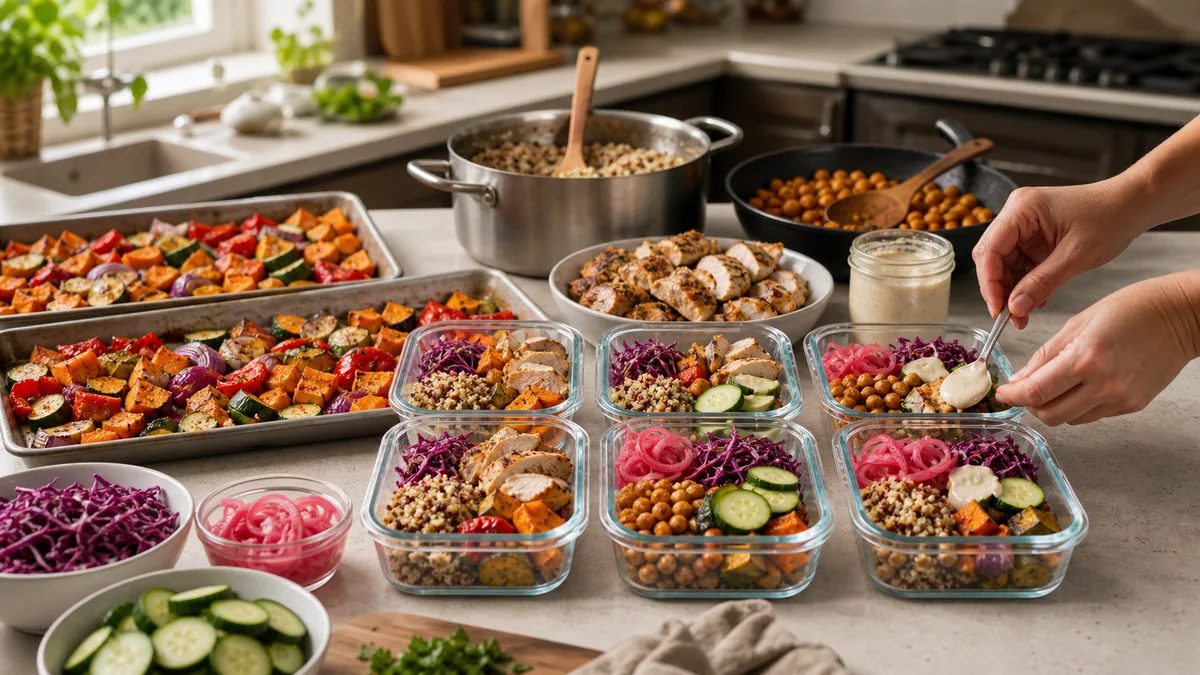
Beans and lentils on first because they need the longest and want nothing from you. Oven on for the traybake and the potatoes. Soup and curry in the gaps. Everything cooled on trays and refrigerated within the two-hour window our storage guide explains.
#What this plan cannot do
It cannot substitute for medication, and nobody should read a menu as a reason to change a prescription.
It also cannot account for you. Blood pressure response to sodium varies between people; cholesterol response to dietary fat varies between people; and family history does not care what you had for dinner. A dietary pattern shifts probabilities across populations — it does not issue guarantees to individuals.
And it only counts if it is what you actually eat. Seven perfect dinners plus a daily takeaway lunch is not a heart-healthy week; it is a heart-healthy hobby.
#Cook the lentil stew first
It is thirty minutes, it costs about two dollars for two people, it lands around 2 g of saturated fat a portion, and it is genuinely good — which is the only reason anyone repeats a meal.
If it works, the rest of the week is variations on that one habit: legumes as the default, olive oil as the fat, and food that you salted yourself.